A common concept amongst 3D engines is the billboard. A billboard is usually a rectangle that is always orientated to face the camera, presenting the viewer with a face that that is always "front on" regardless of the cameras orientation. More often than not appropriately textured billboards are used in great numbers to represent effects like smoke, rain, snow or fire. This is because billboards require very little processing power: a rectangle is just two triangles, and most modern systems measure triangle throughput in the millions per second. But sometimes you just want to show a 2D object in a 3D world - maybe an icon that hovers over an object or perhaps some text that would be awkward or unpractical to render as a 3D object.
Continue reading...27. April 2009
Flash Lite runtime is optimized for small electronic devices, mainly for mobile phones. As the name suggests, it’s lighter than the normal Adobe Flash Platform. It emphasizes on low CPU usage, file size and memory usage. You can create all sorts of content with Flash Lite, for example games, animated screensavers, wallpapers, and maps. In this tutorial I’ll teach you how to create your very own Flash Lite application for a mobile phone! The application will send an email to an address you specify.
Continue reading...22. April 2009
This tutorial will allow you to learn to create custom Flash Components using Actionscript 3.0. I have opted an image gallery component where we would show thumbnails of various images and user could see respective enlarged image by clicking any of the thumbnail. I have used FlickR image search to show various images using this component.
Continue reading...20. April 2009
In the last Flex/Alternativa3D tutorial you saw how to respond to mouse events that involve Alternativa 3D objects. Once the view was set to be interactive handling mouse events was actually pretty straight forward: you simply attach an event listener to the Alternativa object, just as you would any normal GUI element like a button or checkbox. In this tutorial we will take this interactivity one step further and allow 3D objects to be dragged around on the screen.
Continue reading...15. April 2009
Flash Platform is a great tool to create games, either for internet or mobile content. With the introduction of Flash 3D Engines, the ability and success of creating flash games is even bigger. In this tutorial we are going to build up a simple sliding puzzle. Puzzle images are dynamically loaded and sliced so you can easily use your own images if you like. Learn, try and leave a comment showing your results.
Continue reading...13. April 2009
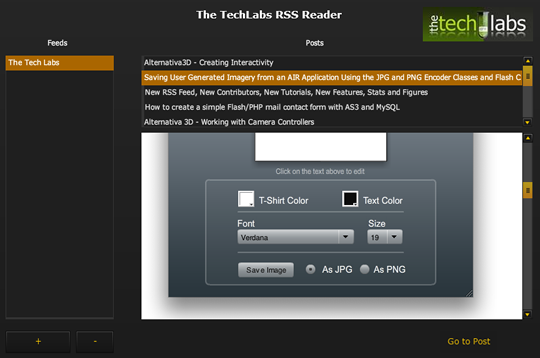
Adobe AIR counts already with over 100 million deployments which represents the importance of this development tool nowadays. Nevertheless still some to get introduced to it and start creating their own applications. In this tutorial you will learn how to create an AIR application a bit different on what we have shown before. I mean, we will be showing how to create a RSS Reader with AIR and PureMVC.
Continue reading...7. April 2009
If you have ever created a traditional forms based application you’ve probably taken it for granted that you can attach functions to mouse events. After all, what good is a button if your program can’t respond to a mouse click? In Flash and Flex applications you listen and respond to mouse events [...]
Continue reading...1. April 2009
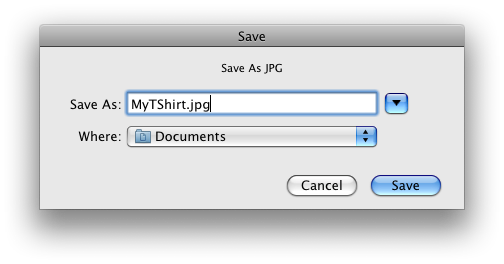
While anyone with an intimate knowledge of encoding bits of information can write their own JPG or PNG encoder, isn't it great to know that Adobe already provides classes to take care of it?
Continue reading...1. April 2009
It's time to check what we did, what we are doing, and what we expect to do. A small report about The Tech Labs, which will help you to understand better how it will be the future in this community.
Continue reading...
29. April 2009
1 Comment