Extending the Actionscript 3.0 / Flash CS3 Slideshow with XML
by 10 September, 2008 11:34 pm79
In this second part tutorial we’re going to add some more features to the slideshow application.
Those would be forwarding and rewinding slides, play and pause the slideshow and linkable slides. If you haven’t read the first part tutorial yet, you should do it before continue. You can read it here.
Requirements
Adobe Flash CS3
Sample files:
Adjust XML structure
To store the link of each slide, we just add it as an attribute to the xml file, or to be more accurate, on the image nodes. We also set the target window of the link, which might be neccesary to set in some cases. So, our xml is looking now like this:
<slideshow>
	<image src="images/fly.jpg" desc="Fly" link="http://www.wikipedia.org" target="_self"/>
	<image src="images/mouse.jpg" desc="Computer mouse" link="http://www.google.com" target="_blank"/>
	<image src="images/country.jpg" desc="Country" link="https://www.thetechlabs.com" target="_self"/>
	<image src="images/rope.jpg" desc="Rope" link="http://www.amazon.com" target="_blank"/>
	<image src="images/flower.jpg" desc="Flower" link="http://www.adobe.com" target="_self"/>
</slideshow>
Adding new objects
Since we know, how the xml looks like, we can move on to the knew stuff on the stage. In the mcInfo movieclip we’ve added 4 new buttons. Pause/Play and Forward/Rewind, which will later be assigned to event listeners. On the main stage is a invisible button as big as the size of the slides which will be used to open the links defined in the xml.
Alright, that’s already enough to go on with the coding part.
Adding new variables
First of all, we need to add some new variables to our script.
To know, if the slideshow is currently playing or paused, we set a flag:
var bolPlaying:Boolean = true;
And we also store the current slide link and target window in a variable:
var strLink:String = "";
var strTarget:String = "";
Init function
This is all we need for the variable. Now let’s take a look about what’s changing in the init function of the slideshow. We added the following two lines at the beginning of the function to prevent the user to click any button as long as the xml file hasn’t been loaded completely:
	mcInfo.visible = false;
	btnLink.visible = false;
We’ve also changed the function that will be called once the slideTimer event is fired. Now the function nextSlide() will be called, which we’ll create later:
slideTimer.addEventListener(TimerEvent.TIMER, nextSlide);
On the last line of the initSlideshow() function we add the event listeners for the buttons. The play and button pause event listeners will be assigned to the same function togglePause(). The next and previous button will be asssigned to the nextSlide() and previousSlide() function. And last of all, we connect the invisible link button that covers the slide area with the goToWebsite() function. And since our slideshow will automatically be playing at the beginning, we hide the play button.
	btnLink.addEventListener(MouseEvent.CLICK, goToWebsite);
	mcInfo.btnPlay.addEventListener(MouseEvent.CLICK, togglePause);
	mcInfo.btnPause.addEventListener(MouseEvent.CLICK, togglePause);
	mcInfo.btnNext.addEventListener(MouseEvent.CLICK, nextSlide);
	mcInfo.btnPrevious.addEventListener(MouseEvent.CLICK, previousSlide);
	mcInfo.btnPlay.visible = false;
onXMLLoadComplete function
Once the xml is completely loaded, we need to show the mcInfo and the button link again. So we add the following two line of code to the function onXMLLoadComplete()
	mcInfo.visible = true;
	btnLink.visible = true;
And since our switchSlide() function will now need to have the index number of the slide, we add a zero as the parameter. We’ll explain the changes in the switchSlide() function later.
switchSlide(0);
NextSlide/PreviousSide function
Let’s take a look at the nextSlide() and previousSlide() functions. They are called when clicking the next and previous button and the nextSlide() function is also called when the Timer event of the sliderTimer has been fired.
The nextSlide() function checks, if there are any slides left to move on. If so, the current switchSlide() function will be called with the next slide index. If there are no more slides left, then the parameter will be zero standing for the first slide.
The previousSlide() function works the same way. If there are slide we can go back, then the switchSlide() function will be called with the previous slide index. If we’re already on the first slide, then we start the slideshow from the last slide with calling the switchSlide() function with the parameter of the total slide count minus one since the array count begins with zero.
function nextSlide(e:Event = null):void {
	if(intCurrentSlide + 1 < intSlideCount)
		switchSlide(intCurrentSlide + 1);
	else
		switchSlide(0);

}

function previousSlide(e:Event = null):void {
	if(intCurrentSlide - 1 >= 0)
		switchSlide(intCurrentSlide - 1);
	else
		switchSlide(intSlideCount - 1);
}
SwitchSlide function
Since the nextSlide() and previousSlide() functions are now handling the checking for the slides, we can take out this part in the switchSlide() function.
To prevent the user from clicking too fast on the next and previous button, we check, if the tweener is still fading in the slides. If so, we just ignore the action. We’re doing this by adding the following if-statement to the first line of the switchSlide() function.
if(!Tweener.isTweening(currentContainer)) {Now we only need to set the new link and the target of it. This will be done exactly the same way as setting the description of the slide.
		strLink		= xmlSlideshow..image[intCurrentSlide].@link;
		strTarget	= xmlSlideshow..image[intCurrentSlide].@target;
FadeSideIn function
The fadeSlideIn() function has also a small addition. We check if the slideshow is currently playing and show the number of seconds to the next slide. If the slideshow is paused, we show a status message. The text will be assigned to the lbl_info label.
	if(bolPlaying) {
		mcInfo.lbl_loading.text = "Next slide in " + TIMER_DELAY / 1000 + " sec.";
	} else {
		mcInfo.lbl_loading.text = "Slideshow paused";
	}
OnSlideFadeIn function
On the onSlideFadeIn() function we now need to check, if the slideshow is playing. If so, we can start the timer again:
	if(bolPlaying && !slideTimer.running)
		slideTimer.start();
TogglePause function
The togglePause() function will be called when the user clicks on the play and pause button. First, we check, if the slideshow is playing, if so, we show the play button, set the bolPlaying variable to false, change the status message of the lbl_info label to “Slideshow paused” and stop the timer.
If the slideshow is currently paused, we show the pause button, set the bolPlaying variable to true again, show the time to the next slide and restart the timer.
function togglePause(e:MouseEvent):void {
	if(bolPlaying) {
		mcInfo.btnPlay.visible = true;
		mcInfo.btnPause.visible = false;

		bolPlaying = false;
		mcInfo.lbl_loading.text = "Slideshow paused";
		slideTimer.stop();
	} else {
		mcInfo.btnPlay.visible = false;
		mcInfo.btnPause.visible = true;

		bolPlaying = true;
		mcInfo.lbl_loading.text = "Next slide in " + TIMER_DELAY / 1000 + " sec.";
		slideTimer.reset();
		slideTimer.start();
	}
}
GotToWebsite function
The last function we need to define is the goToWebsite() function. This function will be called once the user clicks on the invisible button. It will check, if the strLink variable is empty or null. If not, the link will be opened.
function goToWebsite(e:MouseEvent):void {
	if(strLink != "" && strLink != null) {
		navigateToURL(new URLRequest(strLink), strTarget);
	}
}
We’ve already reached the end of the second part of the slideshow tutorial. We hope that you enjoyed reading it and we appreciate any kind of feedback.
Note
The feature for clicking the invisible button only works, when you’re running the flash on a webserver or in the flash sdk.
Full code with comments
// import tweener
import caurina.transitions.Tweener;

// delay between slides
const TIMER_DELAY:int = 5000;
// fade time between slides
const FADE_TIME:Number =	1;

// flag for knowing if slideshow is playing
var bolPlaying:Boolean = true;
// reference to the current slider container
var currentContainer:Sprite;
// index of the current slide
var intCurrentSlide:int = -1;
// total slides
var intSlideCount:int;
// timer for switching slides
var slideTimer:Timer;
// slides holder
var sprContainer1:Sprite;
var sprContainer2:Sprite;
// slides loader
var slideLoader:Loader;
// current slide link
var strLink:String = "";
// current slide link target
var strTarget:String = "";
// url to slideshow xml
var strXMLPath:String = "slideshow-data.xml";
// slideshow xml loader
var xmlLoader:URLLoader;
// slideshow xml
var xmlSlideshow:XML;

function initSlideshow():void {
	// hide buttons, labels and link
	mcInfo.visible = false;
	btnLink.visible = false;

	// create new urlloader for xml file
	xmlLoader = new URLLoader();
	// add listener for complete event
	xmlLoader.addEventListener(Event.COMPLETE, onXMLLoadComplete);
	// load xml file
	xmlLoader.load(new URLRequest(strXMLPath));

	// create new timer with delay from constant
	slideTimer = new Timer(TIMER_DELAY);
	// add event listener for timer event
	slideTimer.addEventListener(TimerEvent.TIMER, nextSlide);

	// create 2 container sprite which will hold the slides and
	// add them to the masked movieclip
	sprContainer1 = new Sprite();
	sprContainer2 = new Sprite();
	mcSlideHolder.addChild(sprContainer1);
	mcSlideHolder.addChild(sprContainer2);

	// keep a reference of the container which is currently
	// in the front
	currentContainer = sprContainer2;

	// add event listeners for buttons
	btnLink.addEventListener(MouseEvent.CLICK, goToWebsite);
	mcInfo.btnPlay.addEventListener(MouseEvent.CLICK, togglePause);
	mcInfo.btnPause.addEventListener(MouseEvent.CLICK, togglePause);
	mcInfo.btnNext.addEventListener(MouseEvent.CLICK, nextSlide);
	mcInfo.btnPrevious.addEventListener(MouseEvent.CLICK, previousSlide);

	// hide play button
	mcInfo.btnPlay.visible = false;
}

function onXMLLoadComplete(e:Event):void {
	// show buttons, labels and link
	mcInfo.visible = true;
	btnLink.visible = true;

	// create new xml with the received data
	xmlSlideshow = new XML(e.target.data);
	// get total slide count
	intSlideCount = xmlSlideshow..image.length();
	// switch the first slide without a delay
	switchSlide(0);
}

function fadeSlideIn(e:Event):void {
	// add loaded slide from slide loader to the
	// current container
	currentContainer.addChild(slideLoader.content);
	// clear preloader text
	mcInfo.lbl_loading.text = "";

	// check if the slideshow is currently playing
	// if so, show time to the next slide. If not, show
	// a status message
	if(bolPlaying) {
		mcInfo.lbl_loading.text = "Next slide in " + TIMER_DELAY / 1000 + " sec.";
	} else {
		mcInfo.lbl_loading.text = "Slideshow paused";
	}

	// fade the current container in and start the slide timer
	// when the tween is finished
	Tweener.addTween(currentContainer, {alpha:1, time:FADE_TIME, onComplete:onSlideFadeIn});
}

function onSlideFadeIn():void {
	// check, if the slideshow is currently playing
	// if so, start the timer again
	if(bolPlaying && !slideTimer.running)
		slideTimer.start();
}

function togglePause(e:MouseEvent):void {
	// check if the slideshow is currently playing
	if(bolPlaying) {
		// show play button
		mcInfo.btnPlay.visible = true;
		mcInfo.btnPause.visible = false;

		// set playing flag to false
		bolPlaying = false;
		// set status message
		mcInfo.lbl_loading.text = "Slideshow paused";
		// stop the timer
		slideTimer.stop();
	} else {
		// show pause button
		mcInfo.btnPlay.visible = false;
		mcInfo.btnPause.visible = true;

		// set playing flag to true
		bolPlaying = true;
		// show time to next slide
		mcInfo.lbl_loading.text = "Next slide in " + TIMER_DELAY / 1000 + " sec.";
		// reset and start timer
		slideTimer.reset();
		slideTimer.start();
	}
}

function switchSlide(intSlide:int):void {
	// check if the last slide is still fading in
	if(!Tweener.isTweening(currentContainer)) {
		// check, if the timer is running (needed for the
		// very first switch of the slide)
		if(slideTimer.running)
			slideTimer.stop();

		// change slide index
		intCurrentSlide = intSlide;

		// check which container is currently in the front and
		// assign currentContainer to the one that's in the back with
		// the old slide
		if(currentContainer == sprContainer2)
			currentContainer = sprContainer1;
		else
			currentContainer = sprContainer2;

		// hide the old slide
		currentContainer.alpha = 0;
		// bring the old slide to the front
		mcSlideHolder.swapChildren(sprContainer2, sprContainer1);

		// create a new loader for the slide
		slideLoader = new Loader();
		// add event listener when slide is loaded
		slideLoader.contentLoaderInfo.addEventListener(Event.COMPLETE, fadeSlideIn);
		// add event listener for the progress
		slideLoader.contentLoaderInfo.addEventListener(ProgressEvent.PROGRESS, showProgress);
		// load the next slide
		slideLoader.load(new URLRequest(xmlSlideshow..image[intCurrentSlide].@src));

		// show description of the next slide
		mcInfo.lbl_description.text = xmlSlideshow..image[intCurrentSlide].@desc;

		// set link and link target variable of the slide
		strLink		= xmlSlideshow..image[intCurrentSlide].@link;
		strTarget	= xmlSlideshow..image[intCurrentSlide].@target;

		// show current slide and total slides
		mcInfo.lbl_count.text = (intCurrentSlide + 1) + " / " + intSlideCount + " Slides";
	}
}

function showProgress(e:ProgressEvent):void {
	// show percentage of the bytes loaded from the current slide
	mcInfo.lbl_loading.text = "Loading..." + Math.ceil(e.bytesLoaded * 100 / e.bytesTotal) + "%";
}

function goToWebsite(e:MouseEvent):void {
	// check if the strLink is not empty and open the link in the
	// defined target window
	if(strLink != "" && strLink != null) {
		navigateToURL(new URLRequest(strLink), strTarget);
	}
}

function nextSlide(e:Event = null):void {
	// check, if there are any slides left, if so, increment slide
	// index
	if(intCurrentSlide + 1 < intSlideCount)
		switchSlide(intCurrentSlide + 1);
	// if not, start slideshow from beginning
	else
		switchSlide(0);

}

function previousSlide(e:Event = null):void {
	// check, if there are any slides left, if so, decrement slide
	// index
	if(intCurrentSlide - 1 >= 0)
		switchSlide(intCurrentSlide - 1);
	// if not, start slideshow from the last slide
	else
		switchSlide(intSlideCount - 1);
}

// init slideshow
initSlideshow();Related posts

Effects / by - 14 January, 2012 5:55 pm
Learn Digital Painting in Photoshop
It’s impossible for everyone to become an artist, but many of them have a will to become an artist, to draw beautiful paintings but again due to lack of command…

Effects / by - 28 December, 2011 2:28 pm
How to Make a New Year Greeting Card in Photoshop
This is so much easy to go in a market and by paying some bucks; purchasing a New Year Greeting Card or any other festival card for your loving person…

Flash / by - 10 August, 2011 4:13 pm
Creating a Gallery in Flash Using the Moto CMS Component
In this tutorial we will create a gallery with the help of the Moto CMS Component. I think many of you have heard about (or even worked with) Moto Flash…
3D / by - 24 July, 2011 5:21 pm
Visualize Your Web Page in 3D
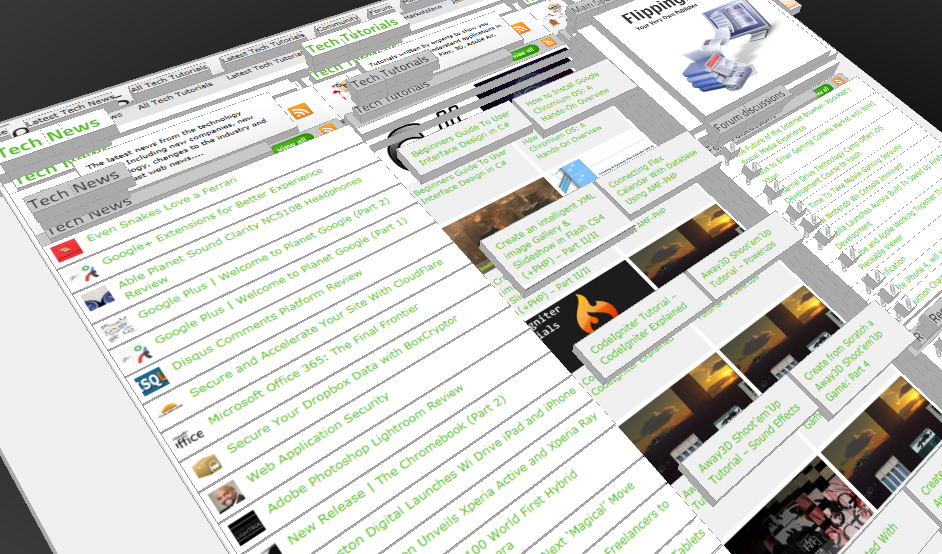
Ever wondered if you could visualize your website in 3D? Well, here’s one such Firefox extension that allows you to do so. Tilt is a Firefox add-on that lets you visualize any web page DOM and provides the relationship between various parts of a website in 3D.
Interfaces / by - 1 March, 2011 2:18 pm
Beginners Guide To User Interface Design in C#
User Interface Design in C# Windows Form Application From Scratch In this C Sharp tutorial you will learn user interface design in C# application. This step-by-step tutorial will help you deeply understand…

Effects / by - 1 December, 2010 2:34 pm
Create an intelligent XML image Gallery & Slideshow in Flash CS4 (+PHP) – Part II/II
In this second part article you will learn how to build an image gallery that will load images from a web server. I decide to call it “Intelligent” because you don’t need to configure any XML or flash file. Just put the Flash movie and the images on a server and they will be loaded automatically. Nice ah?
Flex / by - 29 May, 2010 2:56 pm
Connecting Flex Calendar With Database Using AMF-PHP
Connecting Flex Calendar with Database using AMF-PHP Part I: Create a Dynamic Event Calendar in Flex Builder 3 with Actionscript 3.0 This is Part II of Create a Dynamic Event…
Server Side / by - 13 April, 2010 2:39 pm
CodeIgniter Tutorial – CodeIgniter Explained
Hello everyone, and welcome to the first CodeIgniter tutorial. What will you learn? 1. What is a PHP Framework? 2. What is CodeIgniter? 3. What is MVC? 4. MVC Pattern…
3D / by - 20 March, 2010 10:00 am
Away3D Shoot’em’Up Tutorial – Powerups
In this article we add some powerups to the game.

3D / by - 15 February, 2010 3:59 pm
Away3D Shoot’em’Up Tutorial – Sound Effects
In this article we add some sound effects to the game.
3D / by - 28 July, 2009 1:00 pm
Create from Scratch a Away3D Shoot’em’Up Game: Part 4
Now that we have the player and some enemies we need for them to be able to interact. This is done through collision detection which you will learn in this fourth part.
Effects / by - 21 July, 2009 1:00 pm
Getting Started With BetweenAS3
There are many popular open source tweening engines in the Flash community today. Numbered among these are Tweener, TweenLite/Tweenmax, Tweensy, and GTween. This is a short look at the capabilities of newcomer to the scene: BetweenAS3. BetweenAS3 is the tweening engine brainchild of Yoshihiro (yossy) Shindo and is available as part of the Spark project (i.e. it is brought to us by one of the same group that brought the world the FLARToolkit for Augmented Reality in Flash and countless other goodies).
3D / by - 15 July, 2009 12:50 pm
Create from Scratch a Away3D Shoot’em’Up Game: Part 3
After you have created the 3D level, in the part 3 of this Away3D series, we will show you how to add the player spacecraft and enemies.
Effects / by - 13 July, 2009 12:30 pm
Create an intelligent XML image Gallery & Slideshow in Flash CS4 (+PHP) – Part I/II
In this article you will learn how to build an image gallery that will load images from a web server. I decide to call it “Intelligent” because you don’t need to configure any XML or flash file. Just put the Flash movie and the images on a server and they will be loaded automatically. Nice ah?
3D / by - 8 July, 2009 1:45 pm
Create from Scratch a Away3D Shoot’em’Up Game: Part 2
In the part 1 of these tutorial series articles we created a framework that we could build off to start making the actual game. Now it’s time to create a 3D level for the player to fly through.
3D / by - 6 July, 2009 12:50 pm
Create from Scratch a Away3D Shoot’em’Up Game: Part 1
Today we start a 9 part tutorial series on creating a Shoot’em’Up game. We will cover all the necessary topics to create it from scratch, which will help you to understand and apply these guidelines to other projects. Ath this first part. we look at getting the Away3D engine up and running by creating a UIComponent that will contain and initialize the necessary Away3D components.
Effects / by - 1 July, 2009 1:00 pm
Build a Creative “Swirl Animated Menu” with Flash CS4
Flash it’s a powerful application and can be really complex, but even beginners can create a cool menu for demonstration or for use in a personal site. The menu that we will create is simple, but the swirl animation is something that you don’t see everywhere, for that I’ve decided to explain one way to make an animation of growing swirls without any Action Script code.You will also learn how to import artwork from illustrator where I’ve pre-made the graphics, the work is very simple and the result will be very cool.
Flash / by - 29 June, 2009 12:00 pm
SWFObject and Best Practice Implementation
With more and more full screen Flash web sites appearing on the internet, it’s important to understand how to properly embed the Flash movie in the browser window.
In this tutorial we will cover best practice embedding of SWF movies using SWFObject with a custom function for adding browser scrollbars for smaller browser windows.
3D / by - 24 June, 2009 12:30 pm
Create a 3D Bowling Game with JiglibFlash and Papervision 3D
Possibly the hottest thing to hit the Flash community since the advent of several excellent 3D engines is the recent debut of 3D physics engines. Here we’ll examine a way of using one of the more popular 3D engines, JiglibFlash, in conjunction with the prominent 3D engine Papervision3D to create a bowling game.
Flex / by - 22 June, 2009 1:00 pm
Create a Dynamic Event Calendar in Flex Builder 3 with Actionscript 3.0
This tutorial will allow readers to create an Event Calendar application using Flex. The final user will be able to plan over a daily, weekly or monthly plan.
You will learn on this step by step Flex tutorial, to create from scratch those Graphic User Interfaces, integrate them, and create a complete Rich Internet Application with a professional look.